


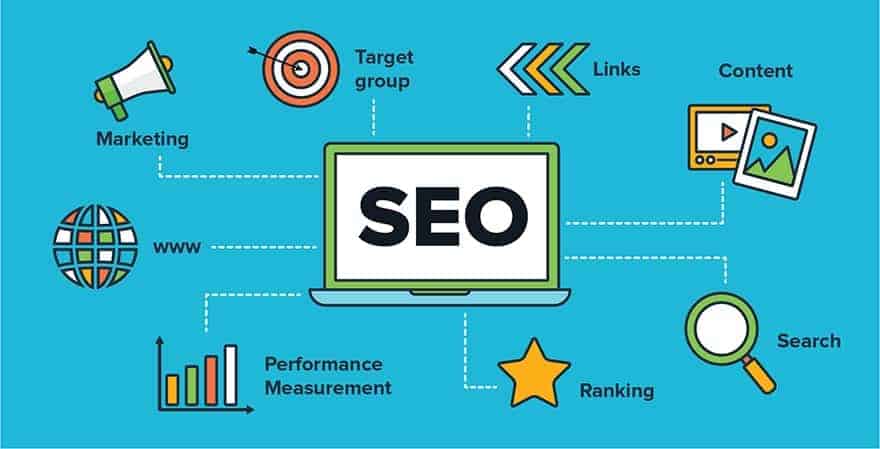
Every day you probably get emails about promoting your website on Google , also known as SEO. But what is search engine optimisation, and why is it just as important as, if not more important than, building a website?
What Is SEO? Definition & How It Works
First of all, search engine optimisation covers all the techniques used to improve a website so that it reaches the top position on Google.
You can do the SEO, or promotion, of your website yourself or hand it over to a company. See an example of how search works, straight from Google itself!
What are the benefits for a website?
- more traffic from search engines
- more sales and more customers through promoting your website
- more targeted traffic, because proper seo is done on targeted keywords related to your line of business.
Promoting a website is an ongoing battle to win the top positions in search engines such as Google

First position on Google
The first thing to check when someone talks to you about first position on Google is whether their own site appears in the top positions on Google.
It is very important to see which keywords someone’s website ranks for on Google. For example, at WebMate we build websites and our main areas of work are Kavala, Drama, Katerini and Xanthi. Ranking first for a general keyword such as “website development” would not be worth much to us and would cost us a great deal. It is more important, and better for us, to rank first for keywords such as “website development Kavala”, “website development Katerini” and so on.
Also, when building a website it helps to be able to meet in person, which is why we mainly target areas we can travel to quickly and at a lower cost.
This doesn’t apply to keywords like website promotion, because as a service it can be delivered just as effectively remotely (when building a site, it is better to analyse the requirements face to face). So for website promotion we aim for the highest possible position with no geographical limits
Of course, we need the right tools to track keyword positions. At WebMate we use Ahrefs and SE Ranking. Below you can see a screenshot of the WebMate page in SE Ranking.

Should we ever stop doing SEO?
What a Google leak taught us about search engine optimisation
Google’s 12 Most Important Ranking Factors
Google uses more than 200 ranking factors, but the 12 below have the biggest influence:
| # | Factor | Impact | How to improve it |
|---|---|---|---|
| 1 | Search Intent Match | Very high | Match the content type to the intent |
| 2 | Content Quality & Depth | Very high | 1,500+ words, original research |
| 3 | EEAT | Very high | Author bios, credentials, sources |
| 4 | Backlinks | High | Quality > quantity, relevant domains |
| 5 | On-Page SEO | High | Title, H1, meta, URL slug |
| 6 | Core Web Vitals | High | LCP < 2.5s, INP < 200ms, CLS < 0.1 |
| 7 | Mobile-First | High | Responsive design, viewport meta |
| 8 | HTTPS / Security | Medium | SSL certificate |
| 9 | User Signals | Medium to high | CTR, dwell time, bounce rate |
| 10 | Structured Data | Medium | Article, FAQ, HowTo schema |
| 11 | Internal Linking | Medium | Topical clusters, descriptive anchors |
| 12 | Content Freshness | Medium | Regular updates, refreshed stats |
All the examples above used various website promotion techniques. The ones we use at WebMate come from experiments we have run, so that we only use the techniques that add value for our clients. After all, Google’s search algorithm has more than 200 ranking factors.
The techniques we focus on are
- Content creation
- Blogging
- Backlink building
- Backlink building on social media
- Website speed
Of course, for the process to work, the right keywords need to be chosen so that the promotion is effective and profitable. For example, if someone pays €2,000 to rank first for the keyword “hotels Kavala” and they actually have rooms to let, it won’t pay off for them. They could pay a smaller amount, maybe a third of that, and reach the top positions for keywords like “rooms to let Kavala”, so that they get targeted visits that bring in profit.
Content creation
To succeed, every website needs content, and rich content at that. It isn’t enough for the texts on your site to be long: they also need to have something to say. For example, look at this site or the site for car anti-theft systems : both have texts that are useful to the customer.

The texts on both sites also offer value and help customers learn something either about the product or about what they are looking for. In both cases the texts are long, more than 1,000 words.
It is very important that the articles and pages on the site link to each other, and that they also have external links to other sites that will help the user.
When we doeffective website promotion, we create the right texts for you and your business. Of course, it is very important that the texts have correct grammar and spelling.
Blogging
Besides the main content of your website, it is very important to have a blog section on it.
Ideally, of course, you or someone else would write articles related to your website’s subject on other blogs, from which you can get visitors and links!
The topics of your articles should be varied but related to your line of business. Your articles should also include keywords and link to each other.
Backlinks
One of the most vital, and most difficult, parts of website promotion and optimisation is link building.
By this we always mean links from other sites to yours, in other words other sites pointing to yours with a hyperlink.
For these links to carry weight, it is important that:
- the hyperlink text is a keyword, e.g. in the anti-theft example the link could be “car anti-theft system”
- the content of the whole page is related to your site
- the content of the article that mentions your site and links to you is related to the page of yours it points to
- the site giving you the link is a quality one. For example, for a car parts site, the best possible link would come from Auto Triti (a well-known Greek car magazine)!
It is very hard to get a good link from another site, and that is what makes the difference in promoting and optimising a website. A link from a very good site may cost several hundred euros if you pay for it, but think how many thousands it might bring back to you!
Backlinks and links with social media

For a few years now, Google has given a lot of weight to social media signals. It does this because they show how important and how well known your business is.
Your website should always have links to all your social media profiles, and all your social media profiles should link to your website, so that Google understands the connection between them.
To a lesser but still important extent, the “followers” of a page also play a role, along with how well known it generally is on social media. Google will favour a well-known website with good awareness.
Website speed

A fast website will be rewarded by Google and by its visitors. We have covered how to make your website fast in earlier articles.
Pay close attention when building your website, and give special importance to hosting for your website’s speed .
In an e-shop speed matters even more, because purchases can happen or not because of it.
On mobile devices your website’s ranking or your e-shop ranking may differ depending on your website’s speed. Google’s results often differ depending on the device the user is searching on and, of course, their location.
Which criteria change the search results?
Above we mentioned that search results can differ on a mobile device. What we need to understand is that search is becoming more and more personalised (and that is Google’s goal).
Google shows each user what interests them most, based on certain criteria, which are usually the following:
- the device the search is made on
- the user’s location
- the user’s browsing history
- the user’s connection speed
- the user’s interests
- whether the user has visited a website in the search results before
- the user’s gender
So your website may appear in first position on Google for one person and in 4th position in another search. With website optimisation , you can be confident that your website will appear in Google’s top positions or on its first page
Below is an image showing the most basic SEO steps a website needs to rank first on Google!

Technical SEO Checklist
Before content marketing and backlinks, make sure your foundations are solid. Here are the 15 basic technical checks:
| Category | Check | Tool |
|---|---|---|
| Performance | LCP < 2.5s | PageSpeed Insights |
| Performance | INP < 200ms | Search Console / CrUX |
| Performance | CLS < 0.1 | PageSpeed Insights |
| Crawlability | robots.txt set up correctly | robots.txt tester |
| Crawlability | XML sitemap submitted | Search Console |
| Crawlability | Internal links correct | Screaming Frog |
| Indexability | No noindex on important pages | Search Console |
| Indexability | Canonical tags correct | Screaming Frog |
| Indexability | No duplicate content | Siteliner |
| Mobile | Responsive design | Lighthouse |
| Mobile | Touch targets > 48px | Lighthouse |
| Mobile | Viewport meta tag | Manual |
| Schema | Article schema | Rich Results Test |
| Schema | FAQ schema | Rich Results Test |
| Schema | BreadcrumbList | Rich Results Test |
On-Page SEO 101: The 8 Elements You Need to Optimise
- Title tag (50–60 characters): primary keyword in the first few words, brand at the end. E.g. ‘What Is SEO & How It Works | Webmate’
- Meta description (150–160 characters): keyword + benefit + CTA. It isn’t a direct ranking factor, but it affects CTR.
- H1 (one per page): usually close to the title but slightly different. It must contain the primary keyword.
- URL slug: short, descriptive, with the keyword. E.g. /seo-guide instead of /article?id=12345
- Heading hierarchy (H1 → H2 → H3): each H2 a sub-topic, each H3 a sub-sub-topic.
- Image optimisation: WebP/AVIF format, descriptive file names, alt text with the keyword where relevant.
- Internal linking: link each page to 3–5 related pages, with descriptive anchor texts.
- Content length & depth: 1,500+ words for competitive topics. Substance in every word, with no ‘fluff’.
AI Overviews & GEO: The New Side of SEO
Since 2024, Google has shown AI Overviews in 18% of searches (Search Engine Land). At the same time, tools such as ChatGPT (~80% market share of AI search engines), Perplexity and Gemini are replacing traditional searches. Modern SEO has to cover these channels too, and this is called Generative Engine Optimization (GEO).
What GEO Is in 2 Minutes
Generative Engine Optimization means optimising content so that AI engines mention (cite) you in their answers. 60–80% of the URLs ChatGPT cites are not on Google’s first page (Ahrefs, 2025). GEO plays by different rules from SEO, and the two reinforce each other.
5 Quick Wins to Get Your Site Ready for GEO
- Answer-first content: give a direct answer in 1–2 sentences at the start of every page.
- Tables & structured data: AI engines pull them easily as citations.
- Statistics with sources: specific figures (like the ones in this article) increase AI citations 3x.
- Presence on Reddit: it is ChatGPT’s #2 source after Wikipedia.
- Schema markup: FAQ, HowTo and Article schema help AI understand your structure.
At WebMate we can help you grow your company online by promoting your website. If you would like a quote, just click the button below!
What is EEAT?
EEAT (Experience, Expertise, Authoritativeness, Trust) is Google’s framework for assessing content quality. It stands for: Experience (real, first-hand experience with the topic), Expertise (knowledge/credentials), Authoritativeness (recognition by other experts), Trust (reliability, sources, transparency). Since 2022 it has been a critical ranking factor, especially for YMYL (Your Money Your Life) topics such as medical, legal and financial ones.
What are Core Web Vitals?
Core Web Vitals are 3 Google metrics for user experience: LCP (Largest Contentful Paint, target <2.5s): how fast the main content loads. INP (Interaction to Next Paint, target <200ms): how fast the site responds to clicks. CLS (Cumulative Layout Shift, target <0.1): visual stability (how much elements ‘jump around’). They have been a ranking factor since 2021.
How many backlinks do I need to reach the first page?
There is no set number. According to Backlinko (an analysis of 11.8M results), the #1 result has 3.8x more backlinks than #2–#10. For competitive Greek keywords it is typically 30–100 quality backlinks. 10 backlinks from high-authority sites (DA 50+) are better than 100 spammy ones. Focus on quality over quantity and on how relevant the linking domain is.
How do I check my rankings?
Free: Google Search Console (official and the most reliable), Ubersuggest free, manual incognito search. Premium: Ahrefs, Semrush, Mangools (€29/month), AccuRanker (€129/month). We recommend GSC for real-user data plus 1 premium tool for competitor tracking.
How fast does SEO work?
SEO goes through 4 stages: (1) Indexing: 1–7 days after the content is created. (2) Initial rankings: 4–8 weeks (usually long-tail). (3) Significant traffic: 3–9 months. (4) Top rankings for competitive keywords: 6–18 months. SEO compounds: the assets you build today bring traffic for years to come.
Want professional help with your SEO?
At Webmate we plan and carry out SEO strategies that bring measurable results, from technical audits to content marketing & link building.



Leave a comment