


Have you ever felt the frustration of watching the traffic to your site go up while your sales stay flat? It is a common problem that hurts every business owner: you have the right product, you have an audience, but somewhere along the way… you lose them.
The secret lies in guiding visitors the right way, and shouting louder rarely helps. This is exactly where the marketing funnel comes in. Don’t let the jargon put you off; in essence, it is the “map” that turns a stranger passing by into a loyal customer. In this article we will leave the complicated theory aside and look at how to set up, in practice, a strategy that works for your business, so you stop missing opportunities and start building relationships.
Contents: marketing funnels

Why are they called funnels?
The term “funnel” comes from the everyday object, and it is used in marketing and sales to describe a process that gradually narrows: from many potential customers down to a few final buyers. If you are looking up “what are funnels” as they are usually used in digital marketing, the core idea is moving and filtering your audience through steps that reduce the numbers but increase the intent to buy.
The funnel analogy
A funnel has a wide opening and a narrow outlet. A marketing funnel works in exactly the same way: many users come into first contact (the wide opening), some show interest, fewer become leads and even fewer become customers (the narrow outlet). The image of the funnel helps us understand the drop-off and the conversion rates at each stage.
Why the name is useful
The name “funnel” describes the shape and also carries the idea of optimisation: by measuring the drop-off at each stage, we can improve the customer journey and increase conversions. It is a visual and practical guide for marketing and sales strategies.
First of all, define your audience
For a marketing funnel to work, we first need to define exactly who our audience is (buyer personas). You might say that anyone could buy your product. I understand, but we need to target the types of people most likely to buy it. How old are they, what gender are they, which country are they from, what are their interests? That way, at the first stage (Awareness), we send the right message only to the people who are interested, making the marketing more effective and saving money. If we don’t know who we are targeting, we waste energy on irrelevant visitors.
A useful tool here, if our website already gets visitors, is Google Analytics. You can find our mini course on YouTube to learn how to use it (the course is in Greek).

Open the demographics report (age, gender, location and so on) and compare the different groups (segments). Who has bought, based on these details?

Once you have done this, let’s look at the stages of a marketing funnel and more.
Marketing funnel stages: the stages of the sales funnel
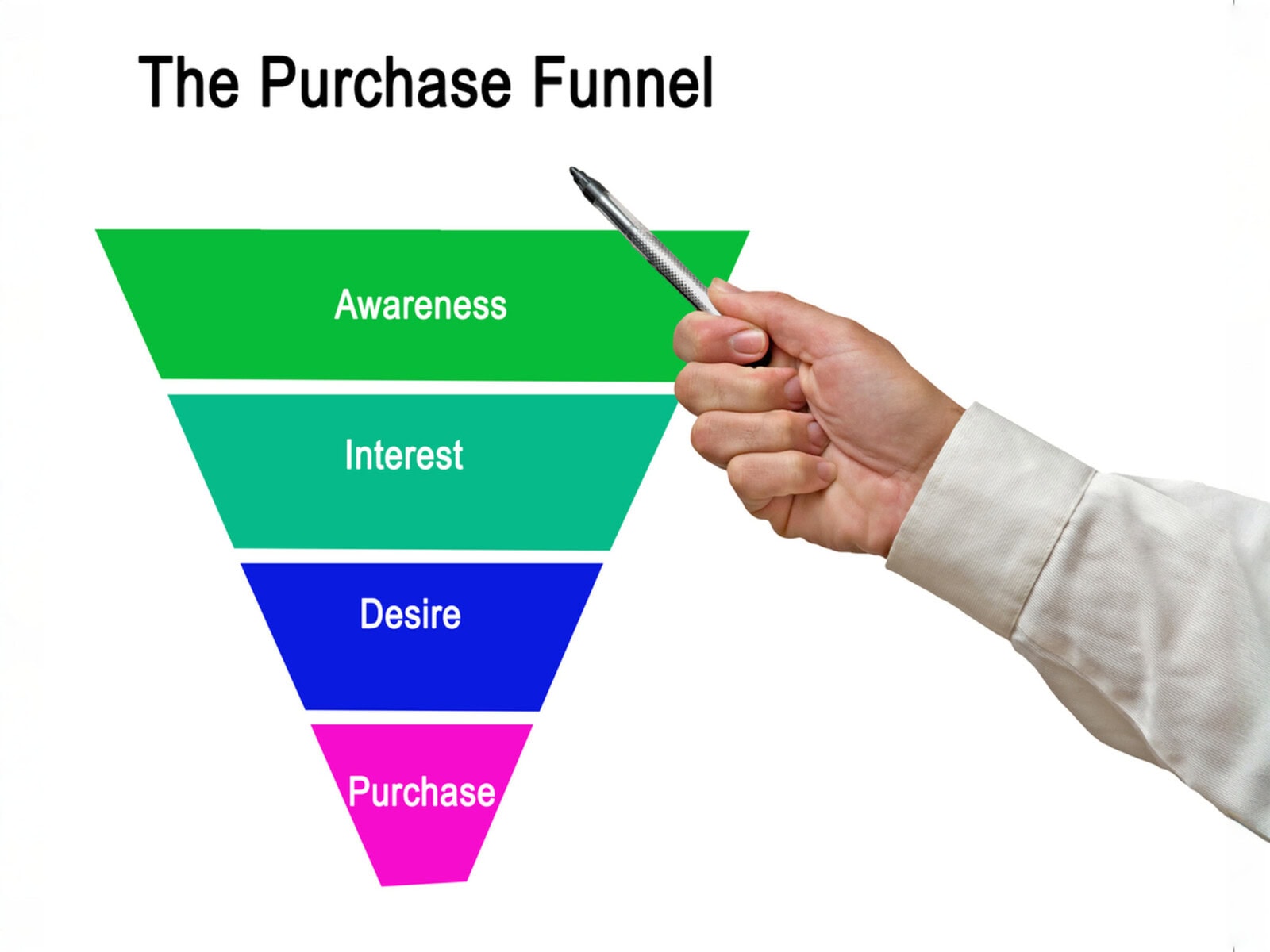
Think of it as the psychological journey a potential customer takes until they feel ready to say “yes”, more than as a technical process. To map out this journey we use the classic AIDA model, which breaks the experience into four distinct steps. Let’s see what exactly goes on in the consumer’s mind at each of them.
Awareness
This is the moment of first contact, the top of the funnel. The user realises they have a problem or a question and “stumbles” upon you while searching on Google or scrolling through social media. Here you are not selling; you are simply saying “Hi, I understand your problem and I know about this”.
Example: A user searches Google for “how to get rid of damp in the house”. They land on your company’s blog post with 5 free tips (SEO & content marketing). You are not selling them a dehumidifier yet; you are simply answering their question.
Interest
Now that they know you, they start “checking you out”. The visitor wants to learn more and is willing to give you a little of their time or their details. The goal is to keep in touch, because if they leave now, they may never come back.
Example: Within the article they read, you offer a free in-depth guide (e-book) called “The ultimate guide to insulation” in exchange for their email. They sign up to your newsletter to download it
Desire
Here we move from logic to emotion. The user receives updates from you and needs to feel that your solution is the ideal one. You have to show them how their daily life will change, using proof to back up your words.
Example: You send them an automated series of emails (email sequence). One email contains a video (case study) of a customer who solved their damp problem using your machine, showing the “before” and “after”.
Action
The moment of truth. The customer is ready, but may get stuck on details (shipping, payment methods, doubts). Here you need to roll out the red carpet: as few clicks as possible and a clear process.
Example: The shopper puts the product in the basket but hesitates. A discreet pop-up appears, or they get a message saying “Complete your order now and get free shipping”. The checkout on the site is fast and doesn’t ask for unnecessary details. If they still don’t buy, you can also use remarketing to show them offers that persuade them.
Retention & Advocacy
The relationship doesn’t end at the checkout. If you look after them now that they have trusted you, they will buy again and, most importantly, they will talk about you on social media.
Example: A week after delivery, you send them an email asking whether everything is fine and asking for a review of your business. At the same time, you invite them to a private Facebook Group with “Tips for the home”, building a community around your brand. Remember: what matters most in marketing, and especially in digital marketing, is keeping these customers, as long as they are happy with the quality of your product or service.
If it still isn’t clear, I have a video that explains a lot in the FREE FACEBOOK COURSE on my YouTube channel (in Greek)
The anatomy of the funnel: TOFU, MOFU, BOFU
To speak the right marketing language, we often split the journey into three “temperature zones”, depending on how ready the user is to buy. Let’s see what the acronyms TOFU, MOFU and BOFU mean and how they shape the content you need to create.

Top of the Funnel: Lead Generation
Here we are at the widest point of the funnel. The audience is “cold”, which means most of them have no idea who you are. At TOFU, your goal is to get them to raise their hand and say: “I’m here and I’m interested in what you’re saying”. Opening their wallets comes later. This is exactly what we call lead generation.
How does it work in practice? The process rests on a simple exchange of value. Nobody gives their email or phone number for no reason. You have to give something useful first, so that you get their contact details afterwards.
For lead generation to work at this stage, you need two key ingredients:
- Content that solves problems (traffic source): You need to create content that answers the questions your audience asks before they buy.
- Blog posts: Articles that answer “how-to” questions (e.g. “How to organise my time”). Social media content: Reels, TikToks or posts that educate or entertain. Podcasts & videos: Rich material that builds authority.
- Blog posts: Articles that answer “how-to” questions (e.g. “How to organise my time”).
- The “bait” (lead magnet): Once they come to your content, how will you keep them? You offer them a lead magnet. This is a free digital product that they get by filling in a form.
- Examples: A checklist, an e-book, a quiz (“Find out your skin type”), a template or access to a free webinar.
The golden rule of TOFU:
Don’t try to sell here! Asking for a purchase at this stage is like proposing on the first date: you will probably scare them off. Focus entirely on educating them and solving their small problems. If you help them for free now, they will trust you enough to pay you later.
Middle of the Funnel (MOFU): Lead Nurture (building the relationship)
Great, you did it! Someone raised their hand and gave you their details. What now? Now the real work begins, and it is called lead nurture.
Think of lead nurture as watering a plant. You can’t plant the seed (lead generation) and expect it to bear fruit the next day without looking after it. At this middle stage the potential customer knows you, but is still evaluating you. They compare your solution with a competitor’s, check the prices and try to find out whether you can really keep your promises.
How do we warm up the audience in MOFU?
The goal here is to turn interest into desire by proving your value. Your main tools are:
Email marketing (the power of communication): We mean a strategic series of emails (email sequences) that deliver real value, never spam.
Welcome email: You welcome them and give them what you promised (the lead magnet). Educational emails: You send them tips that solve small problems, without asking for money. Storytelling: You share your company’s story or your values so they can identify with you. Welcome email: You welcome them and give them what you promised (the lead magnet). Educational emails: You send them tips that solve small problems, without asking for money. Storytelling: You share your company’s story or your values so they can identify with you.
Proof and expertise (social proof): At this stage the customer has doubts: “What if it doesn’t work for me?”. The answer comes from the right content:
Case studies: Show how you helped other customers with similar problems. Webinars: A free online seminar where you teach them live (it shows you are an authority). Reviews & testimonials: Nothing persuades people more than the kind words of others.
- Case studies: Show how you helped other customers with similar problems.
- Webinars: A free online seminar where you teach them live (it shows you are an authority).
- Reviews & testimonials: Nothing persuades people more than the kind words of others.
- Retargeting: Through ads (Meta Ads/Google Ads), you remind people who visited your site but haven’t bought yet that you are there, now showing them more specific messages (e.g. “Seen this product? See what our customers say”).
The secret of MOFU
The key word is consistency. If you show up in their inbox or their feed with useful material, as well as offers, you build what is called “top of mind awareness”. When the time comes to buy, they will think of you first, because you have already helped them.
Bottom of the Funnel (BOFU): Sales & Conversion (the moment of truth)
We have reached the finish. The potential customer knows you (TOFU), trusts you and has understood that you have the solution (MOFU). They are “warm”. Even so, many businesses stumble just before the finish line. Why?
Because the moment of payment always causes the buyer a little anxiety. “What if I’m making a mistake?”, “What if it isn’t right for me?”. At the BOFU stage, your job is to remove every trace of doubt and make buying the easiest, most logical move in the world.
How do we turn interest into a sale?
General information is no longer needed here. What you need is a clear call to action (hard CTA) and the removal of obstacles.
- Ask only for the details you really need.
- Offer a choice of payment methods (card, PayPal, cash on delivery).
- The fewer clicks to completion, the higher the conversion rate.
What BOFU is about
Here we stop being shy. We ask for the sale clearly, while making sure we hold the customer’s hand until we receive the order confirmation email.
Why does your business need one?
Many business owners fall into the trap of believing that marketing simply means “I throw money at ads and wait for sales”. But if you do that without a strategy, it is like trying to fill a bucket full of holes: however much water you pour in, in the end it will be empty.
The marketing funnel is what plugs the holes. It is a tool for survival and growth, and far from a luxury. Here is why:
- You stop selling “blind” (better ROI): Without a funnel, you try to sell the same thing to everyone at the same time. That is a waste of money. A funnel lets you separate the “passers-by” from the people who are genuinely interested, so you spend your ad budget only where there is a chance of profit.
- It runs on “autopilot” (automation): You can’t be glued to your phone 24/7 answering questions and persuading customers. A well-built digital funnel works for you while you sleep. It sends the emails, gives the information and leads the customer to the checkout, without you having to be there.
- It builds trust (which brings sales): Online, people don’t buy from strangers. A funnel gives the customer time to get to know and trust you (through content and nurturing) before you ask them to pay. Statistically, customers who have gone through a nurturing process spend more money than “cold” visitors.
- You pinpoint exactly where the business is struggling (measurability): If you have no sales, is it the ads? The price? The site? Without a funnel you are just guessing. With a funnel you see the numbers and you know: “Ah, I have lots of visitors (good TOFU), but nobody gives me their email (poor MOFU)”. So you fix only what is broken, without starting everything again from scratch.
Content strategy for each stage in digital marketing
The biggest mistake businesses make in digital marketing? They try to sell to someone who has only just met them. It is like walking into a shop and having the sales assistant push the card machine in your face before you have even looked at the clothes.
The magic of the “funnel” is that it tells you exactly what content the user needs at each stage, so they feel that you understand them. The right content at the right time is what nudges the user to the next step.
Let’s see what we “serve” at each stage:
1. For the awareness stage (TOFU): easy to digest & educational Here people are in a hurry and have a short attention span. We want content that is consumed quickly, catches the eye and answers questions without asking for anything in return.
- Blog posts: “How-to” articles or lists (e.g. “7 ways to…”).
- Social media videos: Short Reels or TikToks that give tips or entertain.
- Infographics: Images that explain complex topics at a glance.
- Purpose: For people to get to know you and like you (traffic).
2. For the interest & desire stage (MOFU): in-depth & specialised Here the user has stopped scrolling and wants substance. They are willing to spend time finding out whether your solution suits them. This is where we give the “dense” knowledge.
- E-books & guides: Detailed PDF guides that people download in exchange for their email.
- Webinars: Live or recorded presentations that show your authority.
- Quizzes: Interactive questionnaires (e.g. “Which service package suits you?”)
- Purpose: To get their details (leads) and build trust.
3. For the action stage (BOFU): persuasive & backed by proof Here we cut the theory. The customer wants proof so they feel safe buying. The content has to shout “We are the best choice”.
- Case studies & testimonials: Success stories from real customers.
Product demos & tutorials: Videos that show exactly how the product works.
- Comparison pages: Tables that show why you beat the competition.
- Purpose: To remove doubts and close the sale (conversion).
4. For the retention stage: supportive. Once they have bought, don’t forget them! The content here should help them enjoy what they bought.
- User manuals & onboarding videos: Guidance on how to get the most out of the product.
- Exclusive newsletters: Offers and news for customers only (VIP treatment).
- Purpose: To keep them happy so they buy again (LTV).
Funnel leaking: where are you losing customers?

Imagine trying to fill a bucket with water when the bottom is full of holes. However strong the tap (your advertising), the bucket will never fill. That is exactly what happens when you have funnel leaking.
It is completely normal that not everyone who visits you buys (that would be a miracle). The problem starts when you see people leaving in large numbers at specific points in the process. If you find these “leaks”, you can fix them and increase your profits without spending a single euro more on advertising.
Where are these holes usually found?
1. The hole at the entrance: lots of clicks, no sign-ups (high bounce rate)
- The symptom: Your statistics show that people click the ad, land on the site and leave within 5 seconds.
- The cause: Usually a message mismatch. If the ad promises “red shoes” and the page people land on shows “clothing in general”, the user gets confused and leaves. Other causes: a slow site, or a site that doesn’t work properly on mobile.
- The fix: Make sure that what you promise in the ad is exactly what people see as soon as they click.
2. The hole in the middle: you have leads, but they ignore you (low engagement)
- The symptom: They have downloaded the free e-book, but they don’t open your emails or click the links.
- The cause: You forgot them or you wore them out. Either you sent nothing for a long time and they went cold, or you bombarded them with offers only (“Buy! Buy!”) without giving any value, so they got bored of you.
- The fix: Create content that genuinely interests them (nurturing) and give them a reason to look forward to your next email.
3. The hole at the checkout: abandoned baskets (cart abandonment)
- The symptom: They get all the way to the well, put the product in the basket, but don’t drink. This is the most expensive leak.
- The cause: Price “shock”. Usually it is down to surprise shipping costs that appear at the end, being forced to create an account (nobody wants to remember yet another password) or a lack of trust in the security of the transaction.
- The fix: Be clear about costs from the start, allow guest checkout and show security badges.
After the sale: building loyalty (the loyalty loop)

There is a big misconception in the market: that once the money is in the till, marketing’s job is done. Wrong. Very wrong. If you treat your customers as “one and done”, you are leaving money on the table.
In reality, the sale is the start of a relationship and far from the end of the road. This is where the traditional funnel turns into a “loop” (the loyalty loop). Why? Because it is 5 to 25 times cheaper to keep an existing customer than to find a new one.
So how do we keep the relationship alive?
1. From the sale to repeat business (retention) The goal here is for the customer to buy more than once. We want them to become a regular, the kind of customer who chooses us without a second thought.
- The experience matters: A good product on its own is not enough. The packaging, the speed and the customer support should make them feel special.
- Ongoing communication: Don’t disappear. Send an email to check they are satisfied, suggest complementary products that go with what they bought (cross-selling) or give them access to perks that only customers have.
- The gain: You increase LTV (lifetime value), meaning the money each customer spends with you over time.
2. From customers to advocates (advocacy) This is the “Holy Grail” of marketing. It is the moment when the customer is so delighted that they start talking about you to their friends, on social media, everywhere.
- Digital word of mouth: Google reviews, unboxing videos on TikTok and Instagram stories from customers are the best (and free) advertising you could have.
- Rewards: Give them a reason to talk. A loyalty programme or a “refer a friend and get a discount” scheme (referral) can work wonders.
- What the loop gives you: When you look after the loyalty loop, your existing customers bring new customers to the top of the funnel (TOFU) without you spending a single euro on advertising. That way, the marketing funnel becomes a self-fuelling growth engine.
How to measure success (KPIs)
There is a saying in marketing: “What isn’t measured can’t be improved”. Setting up a funnel without tracking the numbers is like driving with your eyes closed: you may be going fast, but you don’t know whether you are heading for the cliff edge or your destination. Key performance indicators (KPIs) are the compass that shows you the health of your business, and far more than dull statistics. They answer critical questions, such as “how much does it actually cost me to win a new customer?” or “which part of the process is leaking and driving people away?”. Without these answers you are relying on luck, and luck is no business strategy.
To get a clear picture, you need to look past the “vanity metrics” (such as likes that bring in no revenue) and focus on results. The most important thing to watch is the conversion rate, the percentage of people who move from one step to the next, because it shows how persuasive you are. But the “Holy Grail” of measurement is the relationship between how much you spend to win a customer (CAC) and how much money that customer brings you overall (CLV). If you manage to make the customer’s value higher than the cost of acquiring them, you know your funnel is profitable and you can safely invest more to grow it
Essential tools
Just as a builder can’t build a house without a hammer and a saw, you can’t set up an automated funnel with just pen and paper. Fortunately, we live in an age where there are tools for every step of the process that do the “heavy lifting” for you. You don’t need all of them, but the ones below make up the basic toolkit of a modern marketer:
- Google Analytics 4 (for analysis): These are your business’s “eyes”. Without it, you are flying blind. You need it to see who visits your site, where they come from, how long they stay and at what point they give up
- WordPress with Elementor, or ClickFunnels (for landing pages): This is where you welcome people. You need a tool that lets you build pages that “sell”, quickly and easily, without having to write code.
- Mailchimp, Acumbamail or ActiveCampaign (for email marketing): The heart of nurturing. These tools let you collect emails, organise them into lists and, most importantly, send automatic messages at the right moment (e.g. as soon as someone signs up, or on their birthday).
- Meta Ads, TikTok Ads & Google Ads (for advertising): These are the “fuel” for your engine. Through these platforms you manage your ads on Facebook, Instagram, TikTok and Google, targeting exactly the audience you want to bring into your funnel
- A CRM such as HubSpot (for customer management): If your business relies on selling services or on B2B, the CRM is your digital notebook. It keeps a history of every contact you have had with a customer, so you always know what stage they are at and what your next move should be
From funnel to flywheel: the next step

If the traditional funnel has one flaw, it is this: it treats the customer as the “end” of the journey. As soon as they come out of the funnel (in other words, they buy), the process stops and you have to put in more energy from the start to find the next one.
This is where the flywheel model comes in to change our thinking.
Imagine a heavy wheel. At first it takes a lot of effort to turn. But once it gets going, its own momentum keeps it moving. In marketing, that momentum is your satisfied customers.
In the flywheel, the customer sits at the centre of the wheel, with no bottom to fall out of. Three forces turn around them:
- Attract: You win attention with useful content (as in TOFU), without being intrusive.
- Engage: You make buying and communicating so easy and pleasant that the customer becomes attached to you.
- Delight: This is the big difference. You offer such a good experience and support after the sale that the customer becomes your promoter.
Why should you care? Because in a funnel you spend energy to win the customer. In the flywheel, the customer stores that energy and gives it back to your business by bringing in friends and acquaintances.
The enemy of the flywheel is friction. Anything that makes life harder for the customer (a slow site, a rude employee, a complicated returns process) slows the wheel down. Your goal is to remove the friction and let the customer experience speed up your growth.
What is the main difference between a funnel and a flywheel?
The main difference is the structure and the goal after the sale. Put simply: the funnel ends at the sale, while the flywheel keeps going and uses happy customers to bring in new ones.
Conclusion
To sum up, remember that success in online marketing is built methodically over time. Creating effective marketing funnels is the heart of a complete marketing strategy that respects the customer journey and leaves nothing to chance. Whether you run social media marketing campaigns or send newsletters, every action should be carefully designed for the specific stage of the funnel the user is at. Don’t stand still: continually improving the process is the secret that will showcase your products or services and, in the end, turn ordinary visitors into loyal advocates of your brand.




Leave a comment