


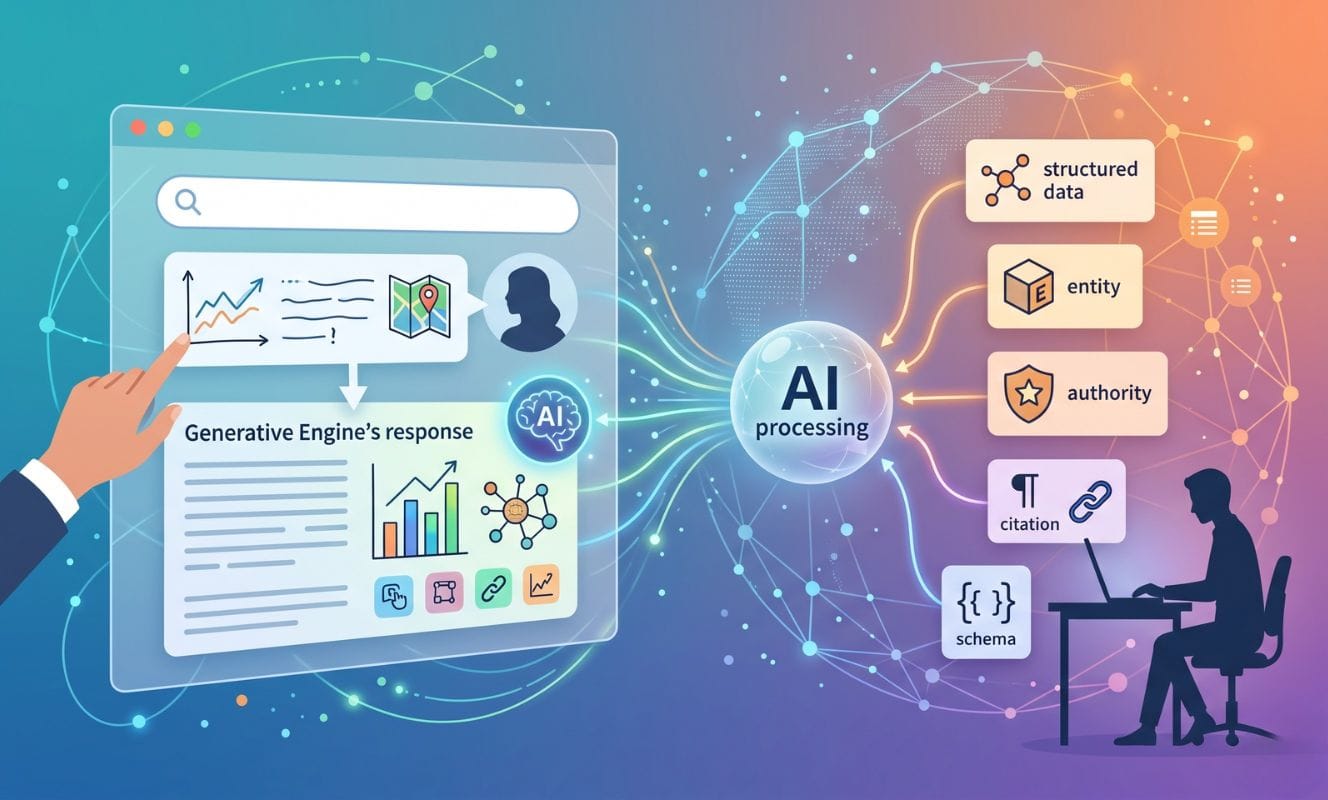
Generative Engine Optimization (GEO) is the new form of SEO for the age of AI search engines: ChatGPT, Perplexity, Gemini and Claude. Traditional SEO aims for rankings on Google, while GEO aims for citations, so that the AI mentions you when someone asks about your brand or your industry.
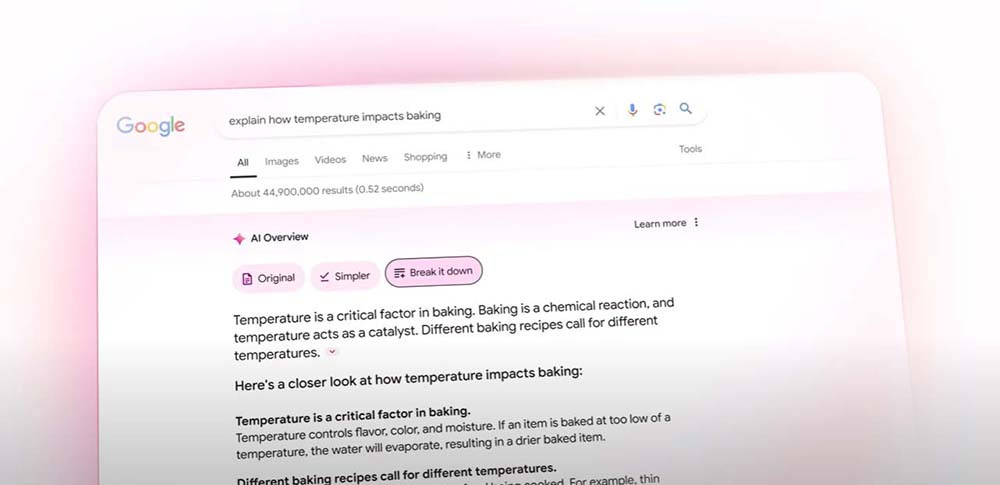
ChatGPT currently holds around 80% of the AI search market (OneLittleWeb, 2025), and Google shows AI Overviews in 18% of searches, a share that keeps growing with Google Gemini. According to Ahrefs, 60-80% of the URLs ChatGPT cites are NOT on the first page of Google. It is a different game with different rules. Businesses that don’t appear in AI answers lose customers before those customers ever reach Google.
In this guide you will learn what GEO is and how it differs from SEO, the 6 AI engines you should target, 10 best practices, the top citation sources, how to measure GEO performance and which tools to use.
GEO vs SEO: What’s the Difference?
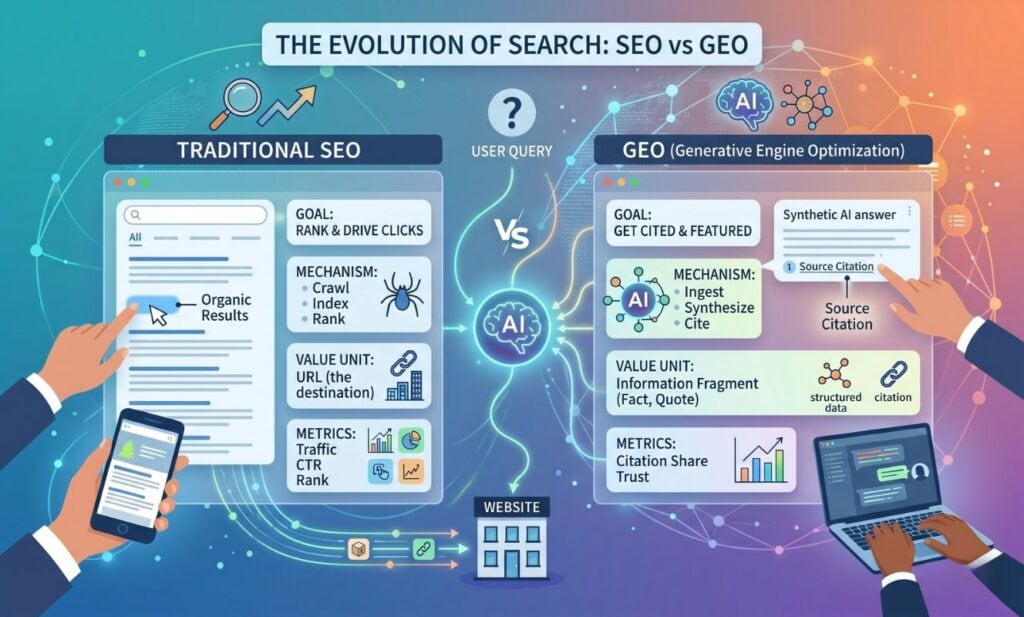
Many people treat GEO as an extension of SEO. In practice it is a parallel channel with its own rules. Here are the 5 key differences:
| Aspect | Traditional SEO | GEO (AI SEO) |
|---|---|---|
| Target | Google rankings (top 10) | AI citations (ChatGPT, Perplexity, Gemini) |
| Success metric | Position #1-10 | Mention frequency, citation quality |
| Source authority | Backlinks + DA | Source diversity + structured data |
| Top citation sources | Authoritative sites with backlinks | Reddit, Wikipedia, comparison sites |
| Content format | Long-form with keyword density | Answer-first with data + structure |
| Volatility | Stable week to week | Variable per query (20-40%) |
| Time to results | 3-9 months | 1-3 months (faster) |
| Tools | Ahrefs, Semrush, GSC | AIclicks, Otterly.ai, Profound |
The 6 AI Engines You Should Target
| AI Engine | Market Share | Citation Pattern |
|---|---|---|
| ChatGPT (OpenAI) | ~80% | Wikipedia (#1), Reddit (#2), authority sites |
| Perplexity | ~5% | Real-time web sources, news, reviews |
| Gemini (Google) | ~8% | Google Search index + curated sources |
| Claude (Anthropic) | ~3% | Web sources + structured data |
| Google AI Overviews | Embedded in Google | Top organic results + niche authority |
| Microsoft Copilot | ~2% | Bing index + Reddit + tech sources |
Note: market share rounded · Data: OneLittleWeb 2025, Sparktoro analysis
Here is a short video on where things stand today
10 Best Practices
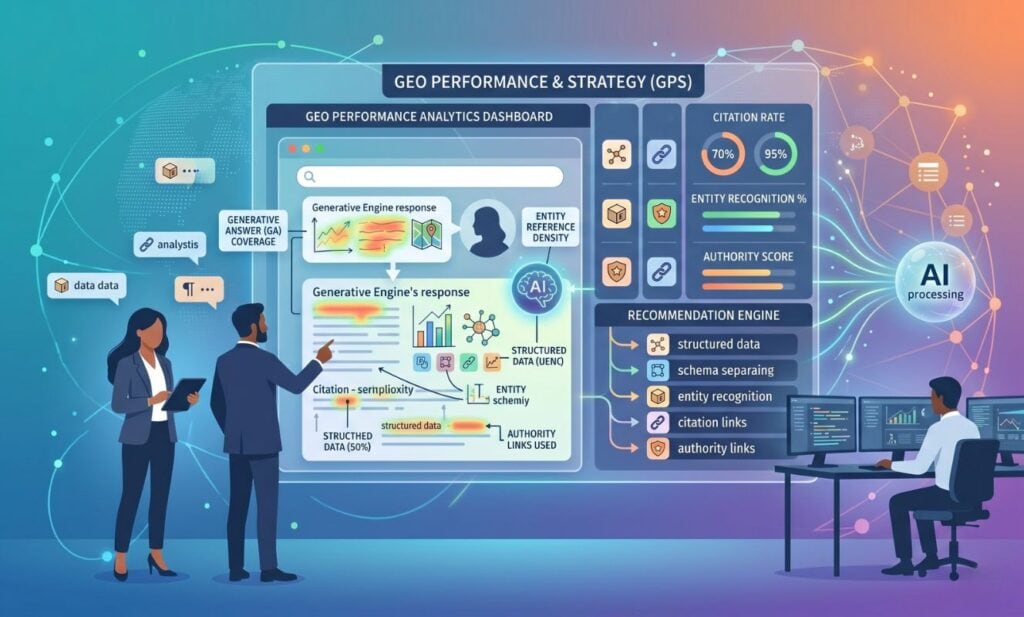
In short: below are the 10 best-proven practices for raising your citation rate in AI engines.
1. Answer-First Content
Open every page with 1-2 sentences that answer the question directly. AI engines pull these sentences as citations. For example, instead of ‘In today’s digital world, SEO is important…’, write ‘SEO is the optimisation of a website so that it ranks higher on Google. It covers 3 areas: technical, on-page and off-page.’
2. Structured Data (Tables, Lists)
AI engines find it easy to pull from tables. A well-structured table with 5-10 rows is 2.4x more likely to be cited than text-only content (AIclicks data 2025).
3. Statistics with Sources
Specific numbers with attributions (‘According to Ahrefs, X%’) increase citations 3x. AI engines prefer content built on data over opinion.
4. A Presence on Reddit
Reddit is ChatGPT’s #2 citation source after Wikipedia. Taking part in relevant subreddits (no spam, just quality content), answering threads and hosting a Reddit AMA are among the highest-leverage tactics.
5. Complete Schema Markup
FAQPage, HowTo, Article, Product, Service and Organization schemas help AI engines understand the structure and intent of a page. Use the Rich Results Test to validate them.
6. Author Authority (EEAT)
AI engines favour content with visible author bylines, credentials and a track record. Add Author schema, an About page and external author profiles (LinkedIn, Twitter, ORCID).
7. Citations from Authority Sites
When your brand is mentioned on Wikipedia, Forbes or in industry publications, your AI trust score goes up. Aim for mentions as well as backlinks.
8. Comparison Content
Pages that compare 5-10 options (‘Best X tools’, ‘X vs Y’) have the highest citation rates. AI engines use them to put together their ‘top picks’ lists.
9. Freshness Signals
AI engines (Perplexity in particular) prefer recent content. ‘Last updated’ dates, mentions of the current year (‘2026’) and freshly published statistics all boost visibility.
10. Multi-Format Content
Combine text, images with alt text and videos with transcripts. Multi-modal AI engines pull from every one of these sources.
Top Citation Sources for AI Engines
These are the sources AI engines use most often for citations (Sparktoro & Surfer SEO data 2025):
| Source | ChatGPT % | Perplexity % | Comment |
|---|---|---|---|
| Wikipedia | 11.3% | 8.7% | Top citation source globally |
| 9.1% | 5.2% | Authentic discussions, real opinions | |
| YouTube | 4.8% | 3.1% | Video transcripts indexed |
| Quora | 3.2% | 2.4% | Q&A format AI loves |
| G2 / Capterra | 2.5% | 4.8% | Software reviews, comparison data |
| Forbes / Industry Press | 2.1% | 3.6% | Authority signals |
| GitHub | 1.9% | 1.2% | Tech / dev focused queries |
| 1.8% | 2.1% | B2B + professional context | |
| Stack Overflow | 1.5% | 1.0% | Technical / programming |
| TripAdvisor | 1.2% | 1.4% | Travel / hospitality |
How to Measure GEO Performance
SEO has Google Search Console (GSC), while GEO measurement is more fragmented. Here are 4 methods:
1. Manual Testing (Free)
Type queries such as ‘Best [service] company in [city]’ or ‘[your brand] reviews’ into ChatGPT, Perplexity, Gemini and Claude. Note whether you are mentioned, in what position, and which sources the AI uses.
2. AIclicks (€39+/month)
The leading platform for GEO tracking. It monitors mentions in ChatGPT, Perplexity and Gemini, with weekly reports, competitor benchmarking and prompt coverage analysis.
3. Otterly.ai / Profound
Specialised AI visibility platforms. Otterly.ai focuses on prompt tracking, Profound on enterprise GEO analytics.
4. Brand Mention Tools
Mention.com, Brand24 and Awario track online mentions in general. They help you find where your brand is being talked about, which indirectly affects AI citations.
The Best AI SEO Tools in 2026
| Tool | Cost | Use |
|---|---|---|
| AIclicks | €39/month+ | AI visibility tracking, multi-platform |
| Otterly.ai | €29/month+ | Prompt tracking, citation analysis |
| Profound | Custom | Enterprise AI analytics |
| Surfer AI | €89/month+ | AI-optimized content creation |
| AlsoAsked | €15/month+ | Question research for GEO content |
| AnswerThePublic | €5/month+ | Question-based keyword research |
| Schema Pro | 79€ one-time | Schema markup automation |
| Frase | €39/month+ | Content briefs with GEO recommendations |
Reddit Strategy for GEO
As Reddit is ChatGPT’s #2 source, the right Reddit strategy is critical. Here are 5 steps:
- Account Warmup: 2-4 weeks of organic activity before you mention your brand. 50+ karma minimum.
- Subreddit Research: find 10-15 relevant subreddits in your industry with GummySearch or Reddit search.
- Quality Comments First: answer 30+ questions without mentioning your brand. Build authority.
- Strategic Brand Mentions: when it is genuinely relevant, mention your brand in comments. Always disclose.
- Long-Term: publish 1-2 quality posts a month with value-first content (no ads). The ‘Show & tell’ format works.
Frequently asked questions
What is GEO compared with SEO?
GEO (Generative Engine Optimization) is the new form of SEO that targets AI engines (ChatGPT, Perplexity, Gemini) instead of traditional Google search. SEO optimises for rankings, GEO for citations. 60-80% of the URLs ChatGPT cites are not in Google’s top 10, so it is a different game with different rules. The two reinforce each other, but they call for different tactics.
How important is GEO?
Very. ChatGPT has around 80% market share among AI search engines, with 800M+ monthly users. Google shows AI Overviews in 18% of searches, with a 30-60% drop in organic CTR where they appear. Businesses that don’t appear in AI answers lose customers at the discovery stage, before those customers even reach Google or your website.
How do I check whether ChatGPT mentions my brand?
Free: type queries such as ‘Best [service] company in [your city]’ or ‘[your brand] reviews’ into ChatGPT and note whether you are mentioned. Premium: AIclicks (€39/month) tracks mentions automatically in ChatGPT, Perplexity and Gemini, with weekly reports and competitor benchmarking.
How long does GEO take to show results?
Less time than SEO. Typically 1-3 months for the first citations and 3-6 months for a consistent presence. The reason: AI engines update their training data more often than most people think, and real-time engines (Perplexity, Gemini) pick up changes within weeks.
Should I give up traditional SEO for GEO?
No. Traditional SEO is still critical, as Google still has 80%+ of search traffic. GEO is complementary: you optimise for both at the same time. Many tactics (answer-first content, schema, structured data) benefit SEO too.
How much does GEO cost?
It varies. DIY with quality content updates: almost free (it costs you time). With tools (AIclicks, Otterly): €30-100/month. Professional agency services: €500-2,000/month depending on scope. For enterprises: €5,000+/month.
Does GEO work for local businesses?
Yes, especially for queries such as ‘best [service] in [city]’. Local SEO + Google Business Profile + local content + local subreddits on Reddit = strong GEO signals for local queries. AI engines give priority to local intent when the query implies it.
Does GEO affect Google rankings?
Not directly. Its tactics (structured data, answer-first content, authority building) do strengthen Google rankings as well. On top of that, the brand awareness you gain from AI citations increases direct and branded searches, which indirectly improves SEO.
Want Professional Help with GEO?
At WebMate we offer GEO consulting & implementation: prompt research, content optimisation, Reddit strategy and AI visibility tracking. We are one of the first Greek agencies to specialise in Generative Engine Optimization.


Leave a comment